I found this very interesting document, excerpts of which are given below. It's an 180 page document listing out all the possible causes of injuries while doing yoga. Most of the notes are by Roger Cole, Ph.D. who is an Iyengar-certified yoga teacher (www.yogadelmar.com), and Stanford-trained scientist. He specializes in human anatomy and in the physiology of relaxation, sleep, and biological rhythms.
It seems, that while yogasanas are meant to improve the spine, current practices tend to worsen the situation. That requires, according to me, a fresh look at the entire issue of the Westernisation of asanas.
"...Of all the disks in the entire spine, the L5-S1 disk is subject to more mechanical stress than any other, so it is injured most often. The L4-5 disk is subject to the second-largest amount of mechanical stress, so it is injured the next most often. The reason these disks take such a beating is that they lie at the "bottom of the totem pole," the base of the vertebral column. This increases mechanical stress in two ways..."
"...Practicing asanas is one of the best things your students can do to maintain healthy backs. However, there are a few mistakes in practice that can seriously injure their backs. One of these is the improper practice of forward bends and twists, which can damage the disks near the base of the spine..."
"...Lotus Pose (Padmasana) is a supreme position for meditation, and Lotus variations of other asanas can be profound. However, forcing the legs into Lotus is one of the most dangerous things you can do in yoga. Each year, many yogis seriously injure their knees this way. Often the culprit is not the student but an overenthusiastic teacher physically pushing a student into the pose..."
"...In a way, Mr. Iyengar may have inadvertently contributed to neck problems in Sarvangasana by pointing out that a truly vertical Shoulderstand is a more powerful and effective pose than a nonvertical one. As more and more people try to mimic Iyengar-style alignment in the pose without using the props he recommends, they run smack into their limited neck flexibility. It's not that a completely vertical Shoulderstand without support is a "bad" pose--in fact, it might be the ideal pose--it's simply that it is so extreme for the neck that only advanced yogis can do it without risking injury..."
"...Sirsasana (Headstand) increases blood pressure in the head the most, because the legs and trunk are maximally elevated and the head is as far below the heart as it can get..."
Courtesy:
http://shivarea.com/Websites/shivarea/Images/Articles%20on%20Yoga%20Injuries.pdf
Friday, October 12, 2007
Selected Article Resources on Yoga Injuries

Thursday, October 11, 2007
Tai Chi vs. Yoga
The postures of hatha yoga provide many of the same health benefits as tai chi chuan. Unfortunately, most of the yoga positions are held for three minutes or longer, which can be very taxing on the body. Brief rest periods are therefore needed. Tai chi practice, on the other hand, does not require any rest period because the postures change too quickly to tire the body.
Yogic inverted postures, such as the headstand and shoulderstand, offer two advantages not found in tai chi chuan. First, they relieve the gravitational pressure on the internal organs and glands. And second, they ease the strain on the heart caused by having to pump blood against the force of gravity. Yoga exercises, however, do little to promote cardiovascular endurance.
Moreover, many people cannot perform certain yoga exercises because of health problems. Tai chi chuan, in contrast, may be practiced in virtually any state of health.
The yoga breathing techniques, known as pranayama, have many health benefits. They increase energy levels within the body, strengthen the immune system as well as the internal organs and glands, reduce stress, purify the body and improve memory. They also enhance the cellular expulsion of carbon dioxide, increase arterial circulation to the brain, reduce levels of lactic acid in the muscles, and stimulate intestinal peristalsis.
Unfortunately, if these exercises are practiced incorrectly, they can cause serious mental disturbances. Tai chi chuan does not present these problems. In tai chi, deep breathing is never imposed on the student; it is developed step by step. The student learns to gradually coordinate his breathing with the movements. This is perhaps the greatest advantage tai chi has over yoga.
In 1978, noted tai chi instructor Lawrence Galante and an associate conducted an experiment to determine whether tai chi chuan is effective in stimulating cardiovascular development. They used 25 tai chi students, ranging in age from 20 to 60 years old, as their models. The students had been studying the yang-style tai chi short form for a period of one to seven years. Galante and his assistant monitored the pulse rate, blood pressure and heart rate of all the students before and after they practiced the form. In all cases, the researchers found that if the form was practiced in a low stance, great cardiovascular stimulation occurred-between 60-80 percent of the maximum heart rate established by the American Heart Association (AHA). On the other hand, if the tai chi movements were performed in a high stance, there was very little heart stimulation (less than 60 percent of the maximum heart rate). However, for people who suffer from high blood pressure, or those recovering from heart attacks or heart surgery, the high stance is a better option. According to Galante, a person can easily meet the standards set by the AHA by practicing tai chi chuan three times a day.
Dr. John Painter, a Fort Worth, Texas based teacher of internal Chinese martial arts, claims that "When the movements of tai chi chuan are performed quickly or in a lower formed stance, they have the same beneficial effect on the cardiovascular system as jogging or high-impact aerobics, but without the stress and strain."
Tuesday, October 9, 2007
TIME magazine Yoga article. Both true and false.
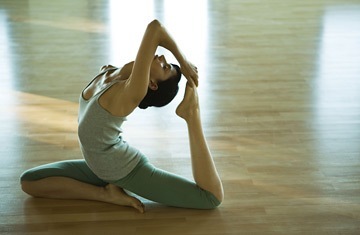
By strange coincidence(?!), TIME has an article on "Yoga" in its current issue. (October 2007). That fits in perfectly with the "Post New Age" theme of this blog, and the first post.
True:
"Amy Toosley was standing in a split pose when her yoga instructor gave her leg a little prod. "I heard the loudest pop I've ever heard, and the instructor said, 'Ooh! Good release, huh?'" Toosley recalls. "Not really--I could hardly walk." With her hamstring muscle snapped, Toosley, 32, avoided yoga for the next three months, and almost a year later, she is still in pain."
Never do more than you are capable. Never hold a position. Always relax after each exercise. No yoga teacher in the world will be able to judge whether you are over-compressing or over-stretching.
False:
"The truth is, yoga, regardless of the form, doesn't offer a comprehensive way to get fit. According to a study by the American Council on Exercise, a national nonprofit organization that certifies fitness instructors and promotes physical fitness, dedicated yoga practitioners show no improvement in cardiovascular health. It's not the best way to lose weight either. A typical 50-min. class of hatha yoga, one of the most popular styles of yoga in the U.S., burns off fewer calories than are in three Oreos--about the same as a slow, 50-min. walk. Even power yoga burns fewer calories than a comparable session of calisthenics. And while yoga has been shown to alleviate stress and osteoarthritis, it doesn't develop the muscle-bearing strength needed to help with osteoporosis."
If the American Council of Exercise (sic) thinks that burning calories is the prime aim of exercise, then I guess that we are pieces of carbon. Yoga (actually "asana") exercises will show an effect in conjunction with diet, reduced stress, and proper sleep.

